Sorry, your browser cannot access this site
This page requires browser support (enable) JavaScript
Learn more >

Crypto

Cognitive Reminder Call

题目

1
2
3
4
5
6
7
8
9
10
11
12
13
14
15
16
17
18
19
20
21
22
23
24
25
26
27
28
29
30
31
32
33
34
35
36
37
38
39
40
41
42
43
44
45
46
47
48
49
50
51
52
53
54
55
56
57
58
59
60
61
62
63
64
65
66
67
68
69
70
71
72
73
74
75
76
77
78
79
80
81
82
83
84
85
86
87
88
89
from binascii import crc32
import os
import secrets
import sys
from cryptography.hazmat.primitives.ciphers import Cipher, algorithms, modes
from cryptography.hazmat.primitives.hashes import Hash, SHA256
from cryptography.hazmat.primitives.padding import PKCS7


def mac(key, message):
return crc32(key + message).to_bytes(4)


def send_authenticated(key, used_nonces, message):
nonce = secrets.token_bytes(4)
while nonce in used_nonces:
nonce = secrets.token_bytes(4)
used_nonces.add(nonce)

tag = mac(key, nonce + message.encode())
print(message)
print(f'Note: This message was sent over an authenticated channel. Its tag is {tag.hex()} with nonce {nonce.hex()}.')


def encrypt(key_parts, message):
iv = secrets.token_bytes(16)

hasher = Hash(SHA256())
for part in key_parts:
hasher.update(part)
key = hasher.finalize()

padder = PKCS7(128).padder()
plaintext = padder.update(message.encode()) + padder.finalize()

cipher = Cipher(algorithms.AES256(key), modes.CBC(iv))
encryptor = cipher.encryptor()
return iv + encryptor.update(plaintext) + encryptor.finalize()


def main():
flag = os.getenv('FLAG')
if flag is None:
print('Please set the flag via env variable!')
sys.exit(1)

enc_key_parts = [secrets.token_bytes(16) for _ in range(4)]
mac_key = secrets.token_bytes(16)
used_nonces = set()

send_authenticated(mac_key, used_nonces, f'Here is the flag: {encrypt(enc_key_parts, flag).hex()}')

enc_key_parts_checksums = list(map(lambda kp: crc32(kp), enc_key_parts))
enc_key_parts = None
send_authenticated(mac_key, used_nonces, 'I have forgotten my key :(\nBut here are 4 congnitive reminders of my key:')
send_authenticated(mac_key, used_nonces, str(enc_key_parts_checksums))

try:
print('Please remind me of my key:')
part1 = bytes.fromhex(input('Part 1 (hex): '))
part2 = bytes.fromhex(input('Part 2 (hex): '))
part3 = bytes.fromhex(input('Part 3 (hex): '))
part4 = bytes.fromhex(input('Part 4 (hex): '))
print('This is an authenticated channel!')
nonce = bytes.fromhex(input('Please provide your nonce (hex): '))
tag = bytes.fromhex(input('Please provide the tag of the concatenation of the nonce and the 4 parts (hex): '))
except ValueError:
print('Invalid hex!')
sys.exit(1)

if len(nonce) != 4:
print('Nonce must be 4 bytes long!')
sys.exit(1)
if nonce in used_nonces:
print('Nonces must not be reused!')
sys.exit(1)
if not secrets.compare_digest(mac(mac_key, nonce + part1 + part2 + part3 + part4), tag):
print('Invalid tag!')
sys.exit(1)
if crc32(part1) != enc_key_parts_checksums[0] or crc32(part2) != enc_key_parts_checksums[1] or crc32(part3) != enc_key_parts_checksums[2] or crc32(part4) != enc_key_parts_checksums[3]:
print('I cannot remember it!')
sys.exit(1)
enc_key_parts = [part1, part2, part3, part4]
send_authenticated(mac_key, used_nonces, f'Thanks for reminding me! Here is a reward: {encrypt(enc_key_parts, flag).hex()}')


if __name__ == '__main__':
main()

saCReT texts

题目

1
2
3
4
5
6
7
8
9
10
11
12
13
14
15
16
17
18
19
20
21
22
23
24
25
26
27
28
29
30
31
32
33
34
35
36
37
38
39
40
41
42
43
44
45
46
47
48
49
50
51
52
53
54
55
56
57
58
59
60
61
62
63
64
65
66
67
68
69
70
71
72
73
74
75
76
77
78
#!/usr/bin/env python
from base64 import b64encode
from math import gcd, lcm
from pathlib import Path
from os import environ, urandom

from Crypto.Cipher import AES, PKCS1_OAEP
from Crypto.PublicKey import RSA
from Crypto.Random.random import getrandbits, randrange
from Crypto.Util.number import getPrime, inverse, size

FLAG = environ["FLAG"]

def EEA(a, b):
if b == 0:
return (a, 1, 0)
g, s, t = EEA(b, a % b)
return (g, t, s - (a // b) * t)


def CRT(r1, r2, m1, m2):
g, k1, k2 = EEA(m1, m2)
assert (r2 - r1) % g == 0, "CRT not possible"
m = lcm(m1, m2)
r = (r1 + m1 * k1 * (r2 - r1) // g) % m
return r, m


# The sacret texts mentioned this problem
# - but not its solution. Can you solve it?

def generate_key(nbits=int("".join(reversed("5202")))): #nbit = 2025
p = getPrime(nbits // 2) # 1012
q = getPrime(nbits // 2) # 1012
N = p * q
φ = (p - 1) * (q - 1)

# 先构造一个 d,再算它的逆 e。
d = 0
while gcd(d, φ) != 1:
dp = getrandbits(nbits // 2 - 1) # 1011
if size(dp) < nbits // 3: # 大于675位
continue

dq = getrandbits((nbits - 1) & ((2 << nbits.bit_length() // 2) - 1)) # 40位
if (dp - dq) % gcd(p - 1, q - 1) != 0:
continue

d, m = CRT(dp, dq, p - 1, q - 1)
d += randrange(0, φ // m) * m

e = inverse(d, φ)
return RSA.construct((N, e, d, p, q))

file = Path("./key")
try:
with file.open("rb") as f:
rsa_key = RSA.import_key(f.read())
except:
rsa_key = generate_key()
with file.open("wb") as f:
f.write(rsa_key.export_key())

aes_key = urandom(32)
nonce = urandom(12)

cipher = PKCS1_OAEP.new(rsa_key)
enc_aes_key = cipher.encrypt(aes_key)

cipher = AES.new(aes_key, AES.MODE_GCM, nonce=nonce)
ciphertext, tag = cipher.encrypt_and_digest(FLAG.encode())

print(rsa_key.public_key().export_key().decode())
print(f"enc_aes_key: {b64encode(enc_aes_key).decode()}")
print(f"nonce: {b64encode(nonce).decode()}")
print(f"ciphertext: {b64encode(ciphertext).decode()}")
print(f"tag: {b64encode(tag).decode()}")

连接服务器可以得到:

1
2
3
4
5
6
7
8
9
10
11
12
13
14
15
16
17
18
19
└─$ nc 10.80.17.81 5202
-----BEGIN PUBLIC KEY-----
MIICGjANBgkqhkiG9w0BAQEFAAOCAgcAMIICAgKB/gC0uMUwDNdTsL14cbF5Gstg
HxeCxOaHQ0+JrTHDBudK44hDL2lUDChgiurLNKz496HSydpRYTIp9dh7lmlXiBUm
a7dY5Hdiv+345/UyAo3OKHRXvjqN+IWvS9oU0V9VL2TQmDUYMJiqE34Hr0SUYC7G
45SxzZUXTPztCgEjd2rpwBlmEXNaNXQGvQaRD5qfys+TPgj5J0kFDHyMjvaM1UtM
0yZ0wc2SN6W3AbUYs8oAc1kUkVA2yQeywCVD6wG5HsDbUrVsQM5zRjxj28iMcBKS
bmMiAYDkKF3JWgPv5tS6vrtL/2ygwEA9BVd9kyxK7/GQxaT4uNUVyCEFBDwbAoH+
AJFZ9VK1IUgJa1fiXsy1/JJQOxcyA+OUe6lrrfoD5lP6Mfz2k92JL0MAB3K4vIs0
OZgwBeUxBEHcjTG4gHigNYaAyq1s8ApQlBCWILWnYAm2ZGCYPxyNX7tvEgQKWL4M
eEXrbn7ME4AsR9s8ReRp0WFVMD3/HU0GGi/nLfu295gVEMcnZaayvZ1nKERgKGLJ
VsVLWV9WJVr54g1s6HMlXn0JofVAr+3FHkBIbZCJrlBdmu+9HKYwExfReI7kqao0
ng2E+xDW4Z574pPz2SMCaiazqIpXqaE2UCFndfraRXe29HUVFbuSGN10w0ge24fr
afWuskQVainfWCzAQjs=
-----END PUBLIC KEY-----
enc_aes_key: RPgWZa2d7sl7ff05Vztd+3LG6MI6mDYCvhQ3nyHerI4xCU1UtVdJAuc3bGd5lH41V/cPnKUSZ3pyQ7ztI5Xkm9JORH9sWZ3XmSGiXYFNBzvDVKB2RCrD9ym+lEqJSytoGf2pLf3LikbCSDWvemw1hbcS1wZO0ZlqDCSAVA4E+VPZMqDG6BtUOjjKoDSXfK6lKvhcf3bMWksLk5OgfqfVU6UPPyGJfOXTkEOzqDJXReodRCvJ2s6rUxVEiJTd6KODp2fMCeFiyobP5aaMc9dWmwgDLhuHcU6AyNP0OS7wk0jRNAuuoxsbCSqS40WsZNGHDkWqOe2PMOexk9ojRA==
nonce: fnW3/7f8REONEpax
ciphertext: fEXUdIK3Lz72A0mI3Qz7JPKIkCOpBqrAM7SfG44p+FQrZ88rwPv4LgRwDewFGXP2brkH8gDxVpS7LOLJ24IQJoEp5vtwhXbjz7Ma33JD0DZV/25RZCiyKC7nY5dZ55s=
tag: 0YLSbUMw0ctRes7Sq6kYTw==

解析一下公钥就可以得到:

1
2
3
4
类型:公钥
n=1359820872970547556173935150474481815717328572399120915602160820069266412576871190208575380021877214003011864598895230655026748175693699868103965991642901738030944778587722779234039114753415014125225674035531145397971360441980034482806466559036689616010630666310492124720494186064419311344084685847839050026833576832529293002210434374767000656025241828574830622784228186168314471906430324965643570616245660239706647219394125532272103687891636739777798439790464477110591936977079814886313654276642341326894390130057950971801433091624348556317803193338841141436337689802023520509335825650275040966262305472134171

e=1093680519331187988756386827314976296267175567662985679284015730888530125712389106904838723896450456481050473532473854286109038539753130314953742249779280534081037838095857594404078189107166916304540993668853664825665486364097797465143273470686376019620959105546726885330925197635832891271094953999640621535438785959658211783138264307339203053235456338179189749603389765405060301866066907397449063487123649421496167346403419323667015826390809458009586469769327999834769109220938532637883503174075741461190855038998041274174429832022456718197273027690130690895156302958624352677158442035485522481200692711146043

分析/思路

这道题的核心漏洞是生成出来的dq太小了:

1
2
3
4
5
6
7
8
9
10
# nbits = 2025
# nbits.bit_length() // 2 = 11/2 = 5
# 2 << 5 = 64
mask = (2 << nbits.bit_length() // 2) - 1 # mask = 64 - 1 = 63

# nbits - 1 = 2024
# 2024 & 63 = 40
dq_bits = (nbits - 1) & mask # = 40

dq = getrandbits(dq_bits) # dq只有40bit

回顾一下在RSA里我们有:

这意味着在模 $q-1$ 下也成立(因为 $\phi(N) = (p-1)(q-1)$):

定义 $d_q = d \pmod{q-1}$,则有:

也就是说存在整数$k$,使得:

根据费马小定理,对于任意 $r$(只要 $r$ 不是 $q$ 的倍数)都有有 $r^{q-1} \equiv 1 \pmod q$。

所以:

这意味着如果我们成功计算出了$d_q$,那么就可以通过计算$\gcd(r^{e \cdot d_q} - r, N)$来求出q。

那么现在的问题就变成了我们该如何得到这个$d_q$。


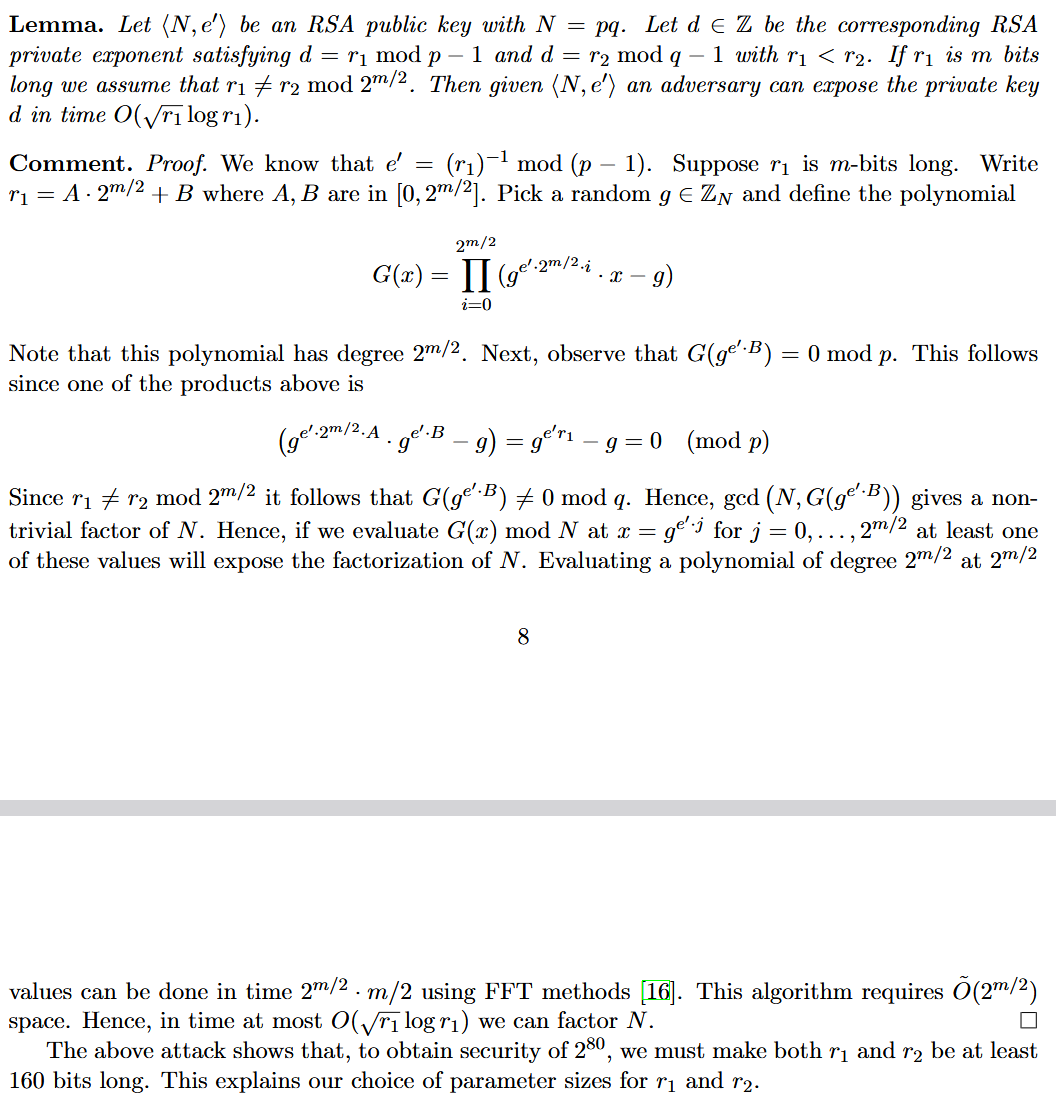
这个情况和这篇论文里第4章的这个lemma的情况完全一样:

Fast Variants of RSA (Dan Boneh, Hovav Shacham)

image-20251128171421900

所以我们可以直接通过实现证明里的算法来得到$d_q$。

这里的方法本质上是爆破,只不过会用Baby-step Giant-step (BSGS)的变种结合快速多项式多点求值来加速。(爆破空间会从原本的$2^{40}$变成$2^{20}$。)

将 $d_q$ 写成:

其中 $D = 2^{20}$(步长)。那么 $0 \le i < 2^{20}$ (Giant steps),$0 \le j < 2^{20}$ (Baby steps)。

我们的目标是找到一对 $(i, j)$ 使得:


具体实现:

  1. 构造多项式 $f(x)$ (Baby Steps):

    定义函数 $f(x)$:

    这里的 $j$ 就是遍历了所有可能的 Baby steps。

  2. 构造求值点 $u$ (Giant Steps):

    构造一系列点 $u_i$:

    这里的 $i$ 遍历了所有可能的 Giant steps。

  3. 碰撞检测 (Evaluation):

    如果我们将正确的 $u_i$ 代入多项式 $f(x)$:

    当 $i \cdot D + j$ 恰好等于真实的 $d_q$ 时,括号里的那一项 $r^{e \cdot d_q} - r \equiv 0 \pmod q$。

    因此,$f(u_i) \pmod q$ 一定为 0。这意味着 $f(u_i)$ 是 $q$ 的倍数。

    计算 $\gcd(f(u_i), N)$ 即可拿到 $q$。

并且代码里使用了eval函数配合子积树(Subproduct Tree),是基于 FFT 运算加速的快速多点求值算法 (Fast Multipoint Evaluation)。所以这份代码的复杂度为$\mathcal{O}(\sqrt{d_q} log(d_q))$。

代码

在WSL里大概需要跑十几分钟才会出结果。

1
2
3
4
5
6
7
8
9
10
11
12
13
14
15
16
17
18
19
20
21
22
23
24
25
26
27
28
29
30
31
32
33
34
35
36
37
38
39
40
41
42
43
44
45
46
47
48
49
50
51
52
53
54
55
56
57
58
59
60
61
62
63
64
65
66
67
68
69
70
71
72
73
74
75
76
77
78
79
80
81
82
83
84
85
86
87
88
89
90
91
92
93
94
95
96
97
98
99
100
101
102
103
104
105
106
107
108
109
110
111
112
113
from base64 import b64decode
from Crypto.Cipher import AES, PKCS1_OAEP
from Crypto.PublicKey import RSA
from sage.all import *


PUBLIC_KEY_PEM = b"""-----BEGIN PUBLIC KEY-----
MIICGjANBgkqhkiG9w0BAQEFAAOCAgcAMIICAgKB/gC0uMUwDNdTsL14cbF5Gstg
HxeCxOaHQ0+JrTHDBudK44hDL2lUDChgiurLNKz496HSydpRYTIp9dh7lmlXiBUm
a7dY5Hdiv+345/UyAo3OKHRXvjqN+IWvS9oU0V9VL2TQmDUYMJiqE34Hr0SUYC7G
45SxzZUXTPztCgEjd2rpwBlmEXNaNXQGvQaRD5qfys+TPgj5J0kFDHyMjvaM1UtM
0yZ0wc2SN6W3AbUYs8oAc1kUkVA2yQeywCVD6wG5HsDbUrVsQM5zRjxj28iMcBKS
bmMiAYDkKF3JWgPv5tS6vrtL/2ygwEA9BVd9kyxK7/GQxaT4uNUVyCEFBDwbAoH+
AJFZ9VK1IUgJa1fiXsy1/JJQOxcyA+OUe6lrrfoD5lP6Mfz2k92JL0MAB3K4vIs0
OZgwBeUxBEHcjTG4gHigNYaAyq1s8ApQlBCWILWnYAm2ZGCYPxyNX7tvEgQKWL4M
eEXrbn7ME4AsR9s8ReRp0WFVMD3/HU0GGi/nLfu295gVEMcnZaayvZ1nKERgKGLJ
VsVLWV9WJVr54g1s6HMlXn0JofVAr+3FHkBIbZCJrlBdmu+9HKYwExfReI7kqao0
ng2E+xDW4Z574pPz2SMCaiazqIpXqaE2UCFndfraRXe29HUVFbuSGN10w0ge24fr
afWuskQVainfWCzAQjs=
-----END PUBLIC KEY-----"""

enc_aes_key_b64 = "RPgWZa2d7sl7ff05Vztd+3LG6MI6mDYCvhQ3nyHerI4xCU1UtVdJAuc3bGd5lH41V/cPnKUSZ3pyQ7ztI5Xkm9JORH9sWZ3XmSGiXYFNBzvDVKB2RCrD9ym+lEqJSytoGf2pLf3LikbCSDWvemw1hbcS1wZO0ZlqDCSAVA4E+VPZMqDG6BtUOjjKoDSXfK6lKvhcf3bMWksLk5OgfqfVU6UPPyGJfOXTkEOzqDJXReodRCvJ2s6rUxVEiJTd6KODp2fMCeFiyobP5aaMc9dWmwgDLhuHcU6AyNP0OS7wk0jRNAuuoxsbCSqS40WsZNGHDkWqOe2PMOexk9ojRA=="
nonce_b64 = "fnW3/7f8REONEpax"
ciphertext_b64 = "fEXUdIK3Lz72A0mI3Qz7JPKIkCOpBqrAM7SfG44p+FQrZ88rwPv4LgRwDewFGXP2brkH8gDxVpS7LOLJ24IQJoEp5vtwhXbjz7Ma33JD0DZV/25RZCiyKC7nY5dZ55s="
tag_b64 = "0YLSbUMw0ctRes7Sq6kYTw=="

rsa_pub = RSA.import_key(PUBLIC_KEY_PEM)
enc_aes_key = b64decode(enc_aes_key_b64)
nonce = b64decode(nonce_b64)
ciphertext = b64decode(ciphertext_b64)
tag = b64decode(tag_b64)

N = rsa_pub.n
e = rsa_pub.e


# 用多点多项式求值爆破 dq,分解 N

R = Zmod(N)
P = PolynomialRing(R, 'x')
x = P.gen()

D = 2**20
r = R.random_element()

# 预计算 u_i = r^(e * i * D)
uu = r ** (e * D)
uv = 1 / uu
u = [(uv := uv * uu) for _ in range(D)]
# 等价于:u = [r ** (e * i * D) for i in range(D)]

# 构造 f(x) = ∏_{j=0}^{D-1} (r^{e*j} * x - r)
fu = r**e
fv = 1 / fu
f = prod((fv := fv * fu) * x - r for _ in range(D))
# 等价:f = prod((r ** (e * j)) * x - r for j in range(D))

# 构造多点求值用的乘积树 M
M = [[x - ui for ui in u]]
while len(M[-1]) > 2:
M.append([M[-1][i] * M[-1][i + 1] for i in range(0, len(M[-1]), 2)])
M.reverse()
def eval_poly_at_points(poly, points, o=0, k=0):
"""
多点求值:对多项式 poly 在 points 上求值,返回一个列表。
使用乘积树 M 做分治。
"""
if len(points) == 1:
return [int(poly(points[0]))]

half = len(points) // 2
pl = points[:half]
pr = points[half:]
fl = poly % M[k][o]
fr = poly % M[k][o + 1]

al = eval_poly_at_points(fl, pl, 2 * o, k + 1)
ar = eval_poly_at_points(fr, pr, 2 * o + 2, k + 1)

return al + ar

a_values = eval_poly_at_points(f, u)

for ai in a_values:
g = gcd(ai, N)
if g != 1 and g != N:
p = g
break
else:
raise Exception("Could not factor N")

q = N // p
assert p * q == N, "Failed to factor N"


# 还原私钥并解密

phi = (p - 1) * (q - 1)
d = inverse_mod(e, phi)

rsa_key = RSA.construct((int(N), int(e), int(d), int(p), int(q)))

cipher_rsa = PKCS1_OAEP.new(rsa_key)
aes_key = cipher_rsa.decrypt(enc_aes_key)

cipher_aes = AES.new(aes_key, AES.MODE_GCM, nonce=nonce)
flag = cipher_aes.decrypt_and_verify(ciphertext, tag).decode()

print(flag)

# └─$ sage solve.py
# PP{wow-that-key-generation-was-complicated-lets-hope-noone-does-that-in-practice::nJF73tSn-YBA}